Most people arriving in Bali for the first time are surprised by how compact the island actually is. Bali covers an area of approximately 5,780 square kilometers, making it smaller than the Australian state of Tasmania and about half the size of Hawaii’s Big Island.
SatuSatu, a Bali travel platform that helps travelers discover and book experiences across the island, often gets asked this question, because understanding Bali’s size is genuinely useful for planning how to move around and how much you can realistically cover in a single trip.
The island stretches roughly 153 kilometers from east to west and about 112 kilometers from north to south at its widest points. Despite that modest footprint, the diversity of landscapes packed into those boundaries is remarkable.
What Bali’s Size Means for Getting Around
Because Bali is compact, it is theoretically possible to drive from one end of the island to the other in a single day. In practice, traffic, especially around Denpasar and the southern corridor between Kuta, Seminyak, and Canggu, significantly extends travel times.
A drive that looks like 30 minutes on a map can take 90 minutes during morning or evening rush hour. The southern tourist belt, stretching from the airport area through Kuta, Seminyak, Canggu, and down through the Bukit Peninsula to Uluwatu, covers a relatively small area but is where most visitors spend the majority of their time.
Ubud sits roughly in the center of the island, about an hour from the coast under normal conditions. The north coast, around Lovina and Singaraja, is further away, typically two to three hours from the south.
Bali’s Geography: More Than Just Beaches
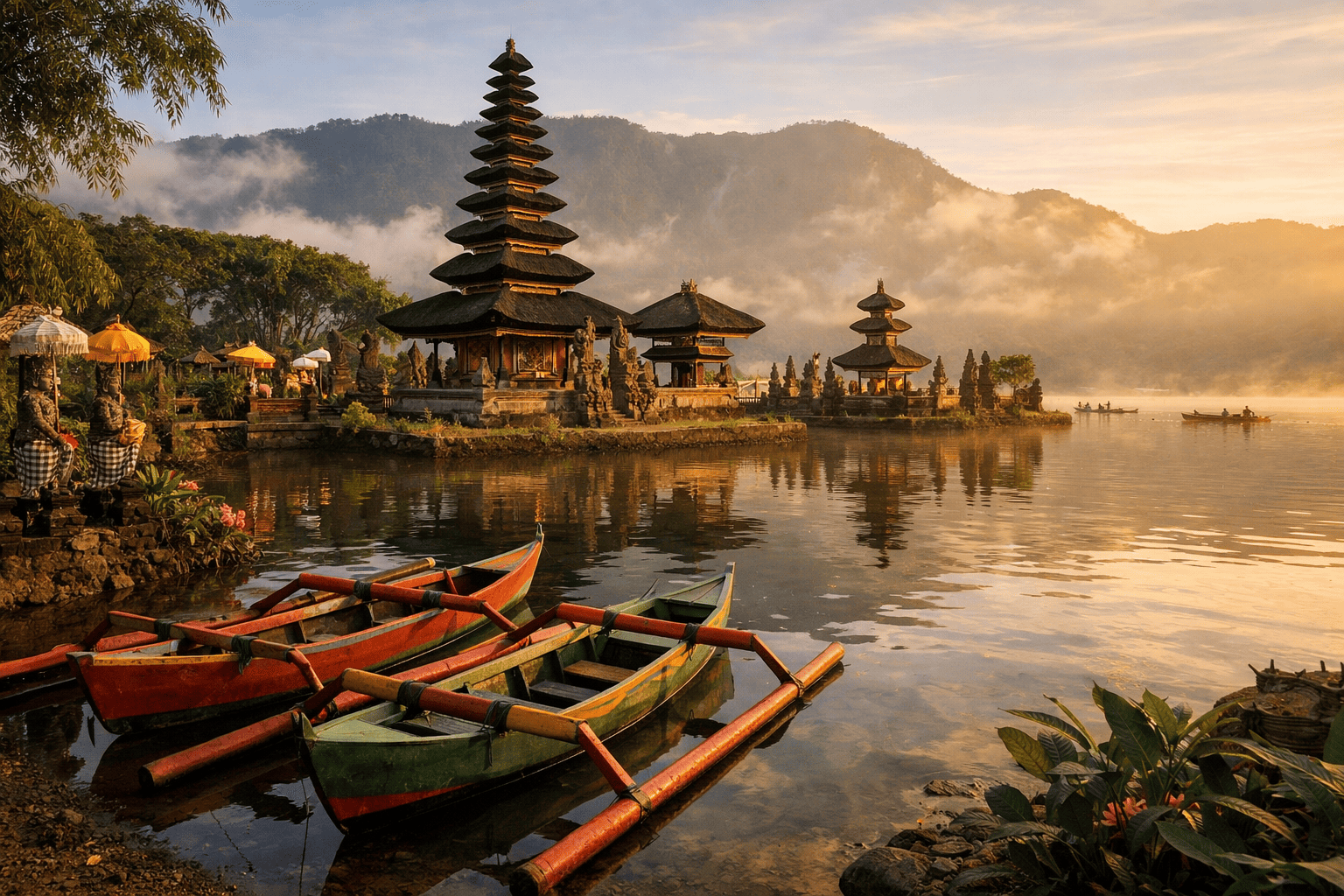
What makes Bali feel far bigger than its square kilometers suggest is the sheer variety of its terrain. The island’s interior is dominated by a volcanic mountain range running roughly east to west.
Mount Agung in the northeast stands at 3,142 meters and is the island’s highest point, considered sacred by the Balinese and still geologically active. Mount Batur, further west in the Kintamani region, is a popular sunrise trekking destination with caldera views that stretch across a crater lake.
South of the mountains, a broad, fertile plain descends toward the coast where most of the rice paddies, temples, and tourist infrastructure sit. The northern slopes are steeper and less developed, and beaches in the north and west often feature black volcanic sand in contrast to the white sand beaches of the south.
Bali also has four crater lakes, Batur, Beratan, Buyan, and Tamblingan, and the longest river on the island, the Ayung, runs approximately 75 kilometers from the northern mountains to the Badung Strait.
Bali’s Nine Regencies and How They Shape Your Trip
Bali is divided into nine administrative districts: eight regencies and the municipality of Denpasar. Each has its own distinct character. Badung Regency covers most of the south including Seminyak, Kuta, Canggu, and the Bukit Peninsula.
Gianyar Regency is home to Ubud, the Tegallalang rice terraces, and much of Bali’s artistic community. Karangasem in the east is where you will find Mount Agung, the Tirta Gangga water palace, and a more rugged, less-touristed coastline.
Buleleng in the north covers Lovina and Singaraja, offering a very different pace and feel from the south. Tabanan to the west includes the Jatiluwih rice terraces, a UNESCO-recognized subak irrigation landscape.
Understanding these regions helps you make smarter choices about where to base yourself and what kind of day trips are realistically within reach.
How Much of Bali Can You Cover in One Trip?
A one-week trip to Bali can comfortably take in two or three distinct regions if you are willing to spend time in transit. A common approach is to base in the south for beach and nightlife, do a two-night stay in Ubud for culture and nature, and perhaps squeeze in a day trip east toward Amed or the water temples.
Trying to cover the entire island in a week tends to result in too much time on the road and not enough time actually experiencing each place.
For a two-week trip, a north coast extension or a few nights on Nusa Penida or Nusa Lembongan, the offshore islands part of the Bali province, becomes very manageable. The compact size of the island means that even ambitious itineraries are possible with a good local driver and flexible scheduling.
Explore Bali Further with SatuSatu
Whether you are mapping out a week across the south or planning a deeper dive into Bali’s interior, SatuSatu.com is the platform that makes it easier. SatuSatu is a Bali travel platform built around locally curated experiences and practical transport solutions, all bookable with instant confirmation.
For getting around the island efficiently, the SatuSatu Exclusive Car Charter gives you a dedicated local driver and completely flexible timing. Whether you are heading into the mountains for a Kintamani drive, down to Uluwatu for sunset, or anywhere in between, the charter adapts to your plan rather than the other way around.
If you are flying into Ngurah Rai International Airport, the SatuSatu Airport Transfer removes the stress of arrival. Book before you land, confirm your pricing upfront, and step off the plane knowing your ride is sorted.
And on any Bali trip, the Uluwatu Temple Kecak and Fire Dance belongs on the list. Held at the clifftop Pura Luhur Uluwatu as the sun goes down over the Indian Ocean, the performance is one of the island’s most dramatic cultural experiences.
SatuSatu handles the booking with same-day availability and bonus merchandise included, and over 1,000 guests have already experienced it through the platform.
Book everything directly on SatuSatu.com with support for BCA, Mandiri, OVO, DANA, credit cards, and other local payment methods.
FAQ about Bali Size
What is the size of Bali?
Bali covers approximately 5,780 square kilometers, making it a relatively compact island. It stretches about 153 kilometers from east to west and around 112 kilometers from north to south.
How does Bali compare in size to other places?
Bali is roughly similar in size to the country of Brunei, about half the size of Hawaii’s Big Island, and significantly smaller than the Australian state of Tasmania. It is the 11th largest island in Indonesia.
Can you drive across Bali in one day?
Technically yes, but traffic in the southern corridor can make even short journeys slow. A full north-to-south drive is possible in a day but not recommended as a sightseeing strategy.
How many districts does Bali have?
Bali is divided into nine administrative areas: eight regencies (Badung, Bangli, Buleleng, Gianyar, Jembrana, Karangasem, Klungkung, and Tabanan) and the municipality of Denpasar.
What is the highest point in Bali?
Mount Agung in the northeast stands at 3,142 meters and is Bali’s highest peak. It is considered the island’s most sacred mountain and remains an active volcano.