There are not many places in the world where you can walk from a Hindu temple gate to a Buddhist vihara, then past a grand mosque, a Catholic church, and a Protestant chapel, all within the space of a single two-hectare compound. In Nusa Dua, Bali, that place is Puja Mandala.
It is one of the island’s most quietly extraordinary sites, drawing visitors not for dramatic scenery or Instagram-ready views, but for what it represents: a living, functioning example of religious coexistence in a nation of extraordinary diversity.
SatuSatu, a Bali travel platform that helps travelers discover and book experiences across the island, put together this guide to help you understand Puja Mandala before you visit.
What Is Puja Mandala?
Puja Mandala, which translates loosely to “a place of worship,” is a religious complex in Nusa Dua that houses five separate houses of worship within one shared compound. Each building is dedicated to one of Indonesia’s five officially recognized religions: Hinduism, Islam, Buddhism, Catholicism, and Protestantism.
The five structures stand side by side without walls or partitions between them, a deliberate architectural statement about the values of tolerance and unity that the complex was built to embody.
The complex was built on 2.5 hectares of land in Kampial Village within the Nusa Dua tourism development zone, on land owned by the Indonesia Tourism Development Corporation (ITDC).
The idea was originally proposed by former tourism minister Joop Ave in the 1980s, groundbreaking began in 1994, and the complex was officially inaugurated in 1997 by the then-Minister of Religious Affairs.
Funding for each house of worship was raised independently by its respective religious community, another meaningful detail in the complex’s story.
Entry to Puja Mandala is completely free. The complex is open for visitors during daylight hours, roughly 8:00 AM to 4:00 PM, though access inside individual places of worship depends on each faith’s own prayer schedule and ceremony times.
The Five Houses of Worship
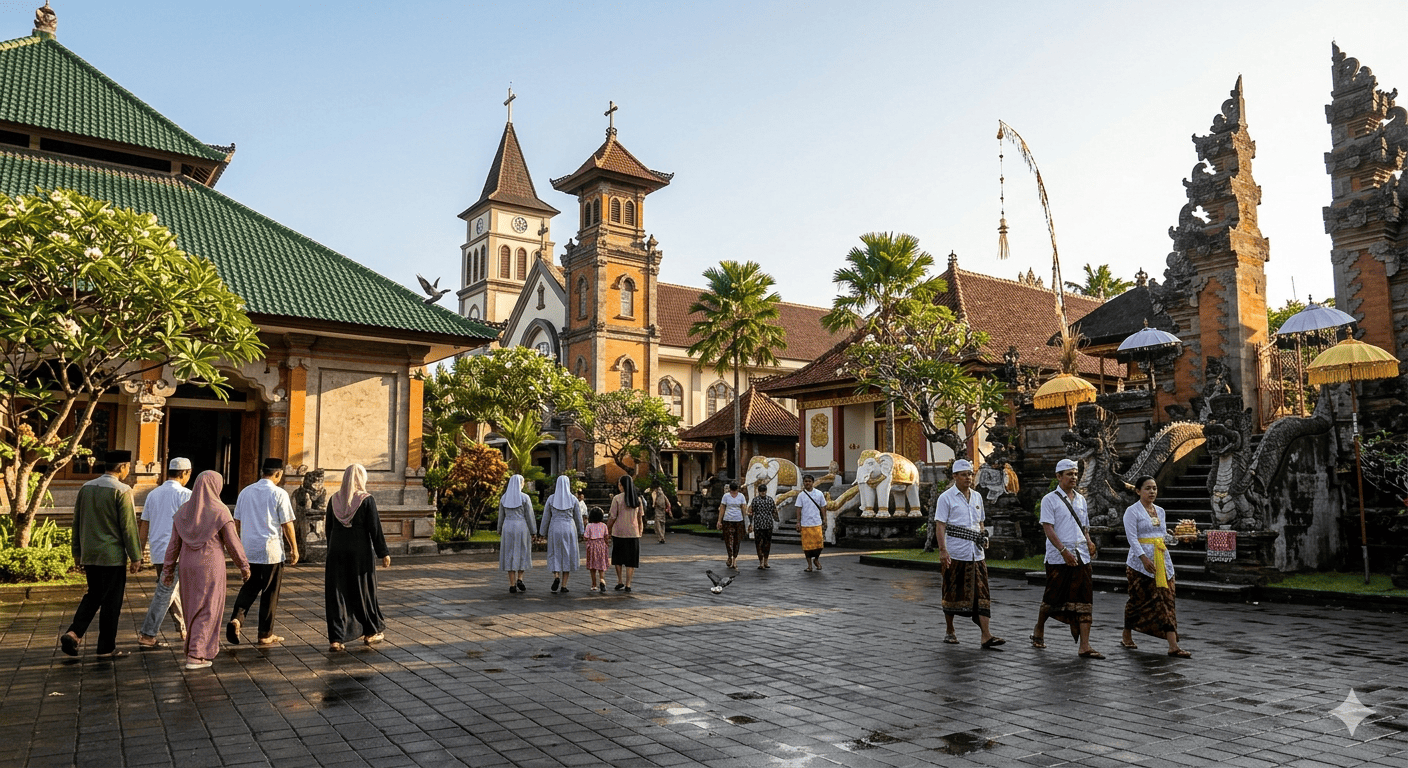
Walking through the compound from left to right, the first structure you encounter is Masjid Agung Ibnu Batutah, the grand mosque. Its bright green tiled prism-shaped roof is immediately distinctive, and multiple flights of stairs lead up to the main prayer rooms with ornate grey ceramic walls and a mihrab.
Among the mosque’s notable possessions is an antique prayer drum and a handwritten Quran housed within the building.
Directly beside the mosque stands the Maria Bunda Segala Bangsa Catholic Church, whose Balinese-style kul-kul bell tower and rooftop crosses create a striking visual blend of European Catholic tradition and local architecture.
Angelic statues perch along the roofline, and the interior maintains the quiet reverence expected of a functioning parish.
At the center of the compound is Vihara Buddha Guna, the Buddhist temple, which draws the eye with large white and gold elephant statues at the entrance, bodhisattva figures guarding the main doors, golden wall motifs, and a prominent dome over the main building.
The interior is ornate and tranquil, with incense often present during active worship periods.
To the right of the Buddhist temple stands the GKPB Jemaat Bukit Doa Protestant Church, which, like its Catholic neighbor, incorporates Balinese-style architectural elements including a bell tower.
This church offers international congregations in both English and Bahasa Indonesia, which makes it one of the more accessible worship spaces for visiting non-Indonesians. Finally, at the far right of the compound sits Pura Jagatnatha, the Balinese Hindu temple.
Built in the same tradition as major Hindu temples across the island, it features the distinctive dragon staircases, carved split gates, and ornately sculpted stone shrines that define Balinese sacred architecture. This temple is dedicated to Jagatnatha, the creator deity in Balinese Hinduism.
The History and Meaning Behind the Complex
The idea behind Puja Mandala came from the rapid development of Nusa Dua in the late 1980s and early 1990s as an international tourism zone.
As hotels and resorts multiplied across the peninsula, community and religious leaders recognized that the needs of Bali’s religiously diverse population, including workers who had moved to the area for tourism-sector jobs, were not being met by the existing infrastructure.
Rather than building separate religious facilities in different corners of the development zone, the decision was made to create one shared space.
The symbolism was intentional: a physical demonstration that Indonesia’s principle of Bhinneka Tunggal Ika, Unity in Diversity, was not just a motto on a national emblem but a lived reality.
Since the complex opened in 1997, it has hosted not only regular daily worship across all five faiths, but occasional interfaith ceremonies where religious leaders gather to celebrate national unity and religious holidays together.
That history matters when you visit. Puja Mandala is not a museum, a theme park of religions, or a tourist attraction designed around photo opportunities. It is a functioning place of worship where people pray every day.
The atmosphere reflects that. There are no aggressive vendors, no crowds of tour buses, and no performance elements. What you find instead is quiet landscaped gardens, shaded walkways, and the occasional overlap of sound: a call to prayer, a choir rehearsal, the soft chanting from the vihara.
How to Visit Puja Mandala
Puja Mandala is located on Jalan Nusa Dua in the Kuta Selatan (South Kuta) area of Badung Regency, approximately 12 kilometers from Ngurah Rai International Airport and 23 kilometers from central Denpasar.
From Seminyak or Kuta, the drive takes around 30 to 40 minutes depending on traffic. The complex has a spacious shared parking lot accessible to all five places of worship.
Dress modestly before you arrive. Shoulders should be covered, and long trousers or skirts that cover the knees are expected. For those entering the Balinese Hindu temple specifically, a sarong and waist scarf are required.
Remove shoes when entering the mosque and the Hindu temple. Photography is welcome in the outdoor areas and at the facades of the buildings, but not during active prayer services.
The best time to visit is early morning, ideally before 10:00 AM, when the light is good for photography and the atmosphere is calm. Late afternoons offer warm golden light and are quieter than midday.
Weekdays tend to be more peaceful than weekends. Puja Mandala pairs naturally with other Nusa Dua attractions: Nusa Dua Beach is minutes away, as is the Museum Pasifika with its Southeast Asian and Pacific art collection, and the Waterblow natural rock formation on the peninsula’s southern edge.
Explore Puja Mandala Bali Further with SatuSatu
After a morning at Puja Mandala, SatuSatu.com is the easiest place to plan and book the rest of your Nusa Dua and Bali day. SatuSatu is a Bali travel platform that brings together transport, curated cultural experiences, and day trips in one place, bookable directly with local payment methods.
The SatuSatu Airport Transfer connects you from Ngurah Rai International Airport to your Nusa Dua accommodation smoothly, with fixed transparent pricing and same-day booking available, no haggling required.
For exploring beyond Nusa Dua, the SatuSatu Exclusive Car Charter gives you a dedicated local driver with fully flexible timing to visit Uluwatu, Seminyak, or the Ubud highlands, all bookable on SatuSatu.com
From Nusa Dua, the SatuSatu Kecak Fire Dance at Uluwatu Temple is one of the most dramatic cultural experiences in all of Bali, held at sunset on a clifftop above the Indian Ocean.
Tickets are bookable directly on SatuSatu.com and make an ideal evening to follow a morning of cultural exploration at Puja Mandala. For families or thrill-seekers in the Nusa Dua area, the Waterbom Bali water park tickets on SatuSatu.com offer a fun, easy day out bookable with private transport included.
All bookings are made directly on SatuSatu.com which supports local payment methods including BCA, Mandiri, OVO, DANA, credit cards, and more.
FAQ About Puja Mandala Bali
What is Puja Mandala Bali?
Puja Mandala is a two-hectare religious complex in Nusa Dua, Bali, where five houses of worship representing Hinduism, Islam, Buddhism, Catholicism, and Protestantism stand side by side in a single shared compound. It was inaugurated in 1997 and is a functioning place of worship as well as a symbol of Indonesia’s religious tolerance.
Is there an entrance fee to visit Puja Mandala?
No. Entry to Puja Mandala is completely free for all visitors. Donations to individual places of worship are welcome but not required.
What are the visiting hours for Puja Mandala?
The complex is generally open to visitors from around 8:00 AM to 4:00 PM. Individual prayer schedules for each house of worship may vary, and access inside each building depends on whether services or ceremonies are in progress.
What should I wear when visiting Puja Mandala?
Dress modestly with covered shoulders and knees. For the Hindu temple, a sarong and waist scarf are required. Remove shoes before entering the mosque and Hindu temple, and maintain respectful silence throughout the complex.
Where exactly is Puja Mandala located?
Puja Mandala is on Jalan Nusa Dua in Kuta Selatan, Badung Regency. It is approximately 12 kilometers from Ngurah Rai International Airport and around 30 to 40 minutes by car from Seminyak or Kuta.