There are temples scattered across every corner of Bali on clifftops, inside caves, beside rice fields, and in the middle of the sea. But none of them carry the same weight as Pura Besakih.
Sitting nearly 1,000 meters up the southwestern slopes of Mount Agung, Bali’s holiest temple is the kind of place that shifts your perspective the moment you arrive.
If you’re building an itinerary around Bali’s most meaningful cultural sites, SatuSatu is the go-to local travel platform for arranging everything from transport to curated experiences all bookable directly on SatuSatu.com
Pura Besakih known widely as the Mother Temple of Bali isn’t a single building or even a single temple. It’s an entire complex of 23 interconnected temples spread across six terraced levels on the volcano’s flank, with the largest and most sacred, Pura Penataran Agung, sitting at its center.
This is a living, breathing place of worship that has been at the heart of Balinese Hinduism for over a thousand years.
What Is Besakih Temple?
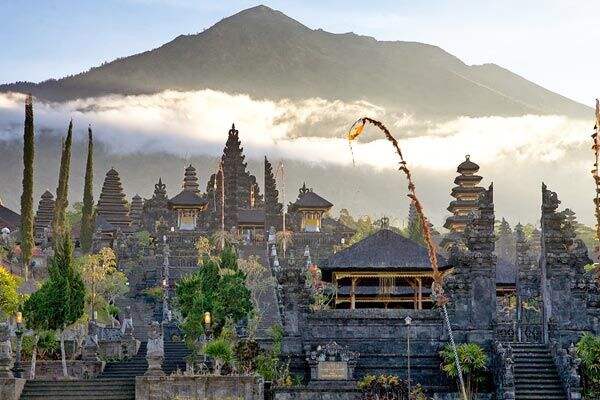
Besakih Temple is the most important, largest, and holiest temple of Balinese Hinduism, perched nearly 1,000 meters up the side of Gunung Agung. It is not a single structure but an extensive complex of 23 separate but related temples, with the largest and most important being Pura Penataran Agung.
The origins of Besakih Temple trace back to prehistoric times. The stone bases of Pura Penataran Agung and several other temples resemble megalithic stepped pyramids, indicating the site has been considered holy for at least 2,000 years.
It was certainly used as a Hindu place of worship from 1284 when the first Javanese conquerors settled in Bali, and by the 15th century, Besakih had become a state temple of the powerful Gelgel dynasty.
The name itself carries mythological weight. The temple’s original name was Basuki, referring to the dragon deity Naga Besukian, believed to inhabit Mount Agung. Over time, the name evolved into Besakih.
That legend isn’t just historical footnote it connects directly to one of the temple’s most remarkable moments in modern history. During a series of eruptions of Mount Agung in 1963, which killed approximately 1,700 people, the lava flows missed the temple complex by mere meters.
The Balinese regarded the saving of the temple as miraculous a signal from the gods that they wished to demonstrate their power but not destroy the monument the Balinese faithful had erected.
Location & How to Get There
Besakih Temple is located in the village of Besakih, Karangasem Regency, in the east of Bali. The temple sits approximately 1,000 meters above sea level on the southwestern slopes of Mount Agung, Bali’s highest volcano.
The journey from most tourist areas in southern Bali takes between 1.5 to 2 hours by car from Kuta or Seminyak, expect around 90 minutes; from Ubud, roughly 60 minutes.
There is no public transport available to get to the temple, making it important for visitors to arrange their own transport to and from the site.
The roads leading to the complex are well-maintained for most of the route but become narrower as you climb toward the temple entrance. Hiring a private driver is the most practical option, both for convenience and for the flexibility to combine the visit with other East Bali attractions.
If your visit aligns well, consider combining it with other activities in Sidemen, about 30 minutes away, or Kintamani, roughly 40 minutes away, to make the most of the long drive out.
Ticket Prices & Opening Hours
The entrance fee to Besakih Temple is IDR 150,000 per person for international visitors and IDR 80,000 for domestic visitors. The entry fee includes a wristband as proof of payment, a sarong rental, a mandatory local guide, and a one-time shuttle bus ticket to the main entrance.
The return shuttle costs an additional IDR 20,000 per person alternatively, you can walk back down in about 10 to 15 minutes. Besakih Temple is open to visitors from 8:00 AM to 5:00 PM daily.
The temple’s sacred areas remain accessible 24 hours for prayer and religious activities. The best time to visit is early morning arriving close to opening time gives you softer light, cooler temperatures, and noticeably fewer people.
Midday visits can feel overwhelming in both heat and crowd volume, particularly during Indonesian school holiday periods and major Hindu ceremonies.
One thing worth knowing honestly: illegal levies carried out by youth from surrounding villages have historically been a problem for tourists visiting this temple.
The situation has improved in recent years following increased supervision and a reformed ticketing system, but the safest approach is to purchase your ticket only at the official counter, stay with your assigned official guide, and politely decline any offers from unofficial guides or vendors within the complex.
What to See Inside
The Besakih complex features 23 temples arranged on parallel ridges across six terraced levels that ascend the southwestern slopes of Mount Agung. Each temple is aligned along a single axis, symbolically guiding worshippers upward on their spiritual journey.
The centerpiece is Pura Penataran Agung, dedicated to Shiva and identifiable by its white banners. This is not just a place of worship but a symbol of the seven layers of the universe, each layer represented through distinct areas within its structure.
The lotus throne, or padmasana, lies at the heart of Pura Penataran Agung and serves as the primary ritual focus where the most significant ceremonies and rituals are conducted.
Flanking Pura Penataran Agung are two other main temples representing the Hindu trinity: Pura Kiduling Kreteg to the right with red banners, dedicated to Brahma the creator, and Pura Batu Madeg with black banners, dedicated to Vishnu the preserver.
The four cardinal temples Pura Batu Madeg in the north, Pura Kiduling Kreteg to the south, Pura Gelap in the east, and Pura Ulun Kulkul in the west complete the cosmological layout of the entire complex.
Each year, at least 70 festivals are held at the complex since almost every shrine celebrates a yearly anniversary a cycle based on the 210-day Balinese Pawukon calendar.
If your visit happens to coincide with a ceremony, you’ll witness something far beyond a typical tourist experience thousands of Balinese pilgrims in white ceremonial dress ascending the temple steps with offerings is one of the most visually and emotionally powerful sights on the island.
Practical Tips Before You Go
A few things that make a genuine difference to the experience. Dress appropriately shoulders and knees should be covered, and a sarong is mandatory. A sarong is provided at the temple and is included in the ticket price. You’ll receive it at the same time as your wristband and must return it at the end.
Bring cash the official ticket counter accepts card in some cases but cash is always safer, especially for parking fees and the return shuttle. The ticket also covers the services of a local official guide, identifiable by their orange batik print shirts and ID tag.
Stick with them and don’t pay for any additional guidance unless you’ve specifically requested it.
Photography is generally permitted in the outer areas of the complex, but visitors should be respectful and avoid photographing actively praying worshippers or entering areas marked for devotees only.
The view of Pura Penataran Agung with Mount Agung rising behind it especially on a clear morning is one of the most photographed images in all of Bali, and for good reason.
What Makes Besakih Temple Special
Besakih is in a category of its own among Bali’s hundreds of temples. The scale is genuinely staggering most first-time visitors arrive expecting something grand and still find themselves underestimating it.
Besakih isn’t just a temple it’s an entire complex, practically a spiritual village that has survived harsh climate, volcanic eruptions, and colonial rule for over a thousand years.
Pura Besakih is the only temple in Bali open to every devotee from any caste group a fact that underscores its unique position not just as the island’s largest temple, but as its most inclusive and universal.
For Balinese Hindus, a pilgrimage here is a deeply personal and significant act. For visitors, arriving with that understanding transforms the experience from sightseeing into something that genuinely lingers.
Explore East Bali Further with SatuSatu
Getting to Besakih from most of Bali requires planning your transport carefully and SatuSatu makes it easy to handle everything in one place, directly through SatuSatu.com with instant confirmation and local support.
The SatuSatu Airport Transfer is the smoothest way to start your Bali trip getting you from Ngurah Rai Airport to your accommodation with transparent pricing, same-day booking, and no haggling on arrival.
The SatuSatu Exclusive Car Charter is the ideal solution for a Besakih day trip, giving you a dedicated local driver with fully flexible timing so you can combine it with Tirta Gangga, Sidemen, or Kintamani without any fixed schedule pressure.
For travelers wanting to experience another of Bali’s most iconic cultural and spiritual sites, the Uluwatu Temple Kecak & Fire Dance SatuSatu Curated Experience on SatuSatu.com is the perfect complement a sunset Kecak performance above Uluwatu’s cliffs that offers a completely different dimension of Balinese temple culture, with same-day booking and exclusive merchandise included.
All bookings are made directly on SatuSatu.com and support local payment methods including BCA, Mandiri, OVO, DANA, credit cards, and more.
FAQ about Besakih Temple
How much is the entrance fee to Besakih Temple?
The entrance fee is IDR 150,000 per person for international visitors and IDR 80,000 for domestic tourists. The fee includes a sarong rental, a mandatory official local guide, and a one-way shuttle to the main entrance.
What is the best time to visit Besakih Temple?
Early morning, as close to the 8:00 AM opening as possible. The light is better, the temperature is cooler, and the crowds are significantly smaller than at midday.
Do I need to hire a guide at Besakih Temple?
A local official guide is included in your entry ticket and is mandatory. They wear orange batik shirts and carry an ID. Do not pay for additional unofficial guides politely decline and stay with your assigned guide.
Can I visit Besakih Temple from Ubud in a day?
Yes, it’s about a 60-minute drive from Ubud. Combining the visit with nearby East Bali attractions like Tirta Gangga water palace or the Sidemen Valley makes the most of the journey.
Is Besakih Temple worth visiting?
Absolutely. It’s genuinely one of the most significant cultural and spiritual sites in all of Southeast Asia. The scale, history, and setting against Mount Agung make it an experience that stands apart from anything else on the island.