Step off the plane at Ngurah Rai, walk into almost any hotel lobby, temple entrance, or village ceremony in Bali, and within minutes you will hear it: “Om Swastyastu.” Spoken with palms pressed together and a gentle bow of the head, this phrase is so woven into daily life here that understanding what it actually means changes how you experience the entire island.
It is not a casual hello, and knowing the difference matters. SatuSatu, a Bali travel platform that helps visitors discover and book authentic local experiences, considers learning Om Swastyastu one of the most meaningful first steps any traveler can take before arriving on the island.
Two words, five syllables, and a depth of meaning that goes back centuries.
What Om Swastyastu Actually Means
The phrase comes from Sanskrit, the ancient language at the heart of Hindu scriptures. It breaks down into three distinct components: “Om,” “Swasti,” and “Astu.” Om is a sacred syllable referring to Sang Hyang Widhi Wasa, the Balinese Hindu name for God.
Swasti, derived from the Sanskrit “su” and “asti,” means something good exists or goodness is present. Astu means “may it be so,” functioning much like “amen” at the close of a prayer.
Put together, the phrase translates roughly as: “May you always be safe and well in the protection of God.” Some Balinese scholars and local sources translate it more fully as a wish for safety, prosperity, and happiness all at once.
What is clear is that this is not a throwaway greeting. Every time someone says it to you, they are, in a real sense, offering you a blessing.
Note on spelling: you will see this written as both “Om Swastyastu” and “Om Swastiastu” across signs, hotel lobbies, and websites. Both are accepted variations of the same phrase, with “Swastyastu” being closer to the traditional Balinese spelling and “Swastiastu” appearing more frequently in modern Indonesian usage.
The Philosophy Behind the Words
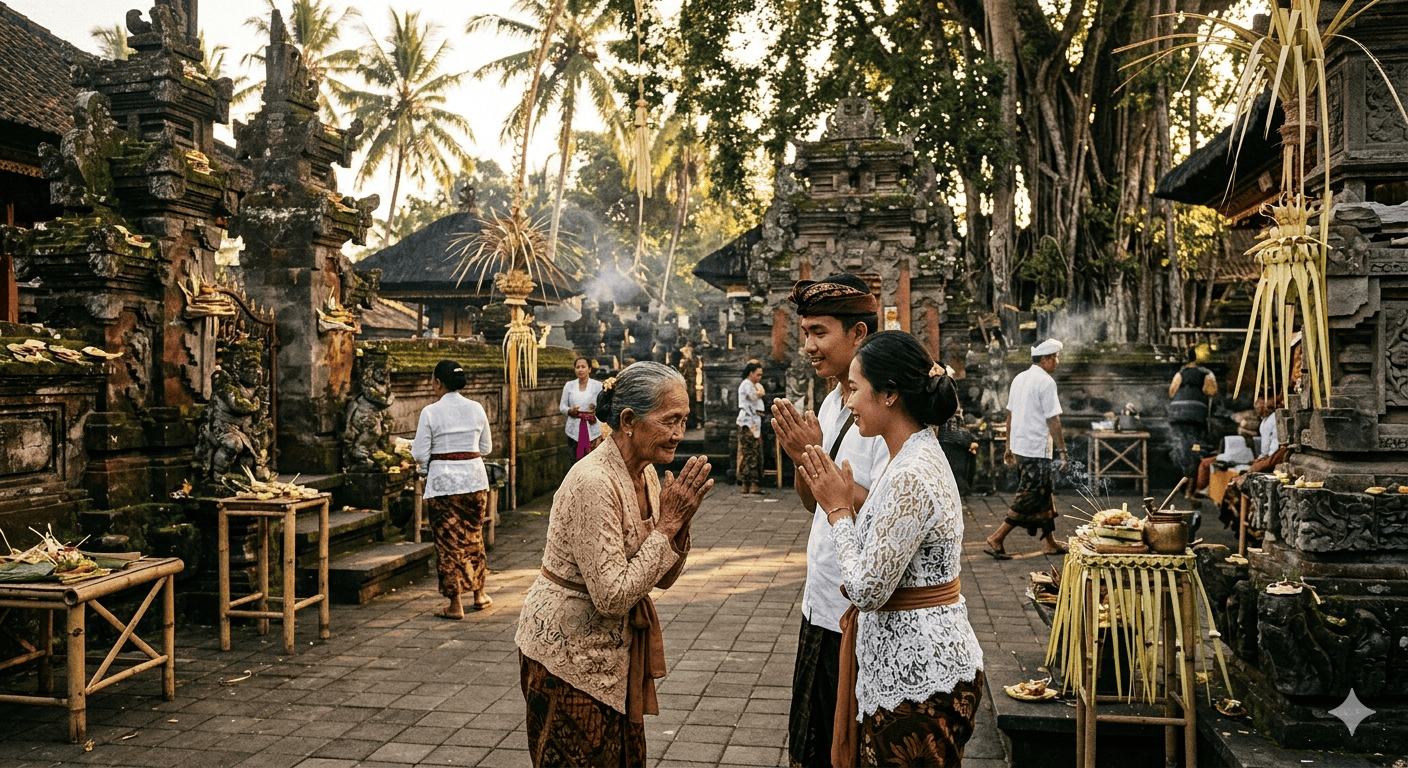
Om Swastyastu is not just a greeting. It is a verbal expression of Tri Hita Karana, the foundational philosophy of Balinese Hindu life.
Tri Hita Karana translates as “three causes of well-being,” and it refers to three sacred relationships: harmony with God (Parahyangan), harmony with other people (Pawongan), and harmony with nature (Palemahan).
When a Balinese person says Om Swastyastu, they are affirming all three of these at once. They are not making small talk. They are acknowledging the divine in themselves and in the person they are greeting, and wishing alignment across all three spheres of life.
This is why the greeting is used to open ceremonies, community meetings, school assemblies, and formal speeches across Bali, not just casual encounters.
The widespread daily use of Om Swastyastu is actually a relatively modern development. Historically, it was reserved for formal religious ceremonies and events.
Over recent decades, it has expanded into everyday social life, becoming the default polite greeting between Hindus across Bali, from the rice terraces of Tegalalang to the fishing villages of Jimbaran Bay.
How to Say It Correctly
Pronunciation matters, though locals consistently say that sincere effort counts for more than perfect delivery. The phrase is broken down syllable by syllable as: Om, Swas, Ti, As, Tu. The rhythm should feel fluid rather than choppy, almost like exhaling rather than reciting.
A common mistake among visitors is over-stressing each syllable separately. Letting the phrase flow in one calm breath gets you much closer to how it sounds when spoken naturally.
The gesture that accompanies it is called Panganjali or Sembah. Press your palms together in front of your chest, fingertips pointing upward but no higher than your chin, and bow your head slightly. In everyday greetings between people of similar standing, hands stay at chest level.
The higher the hands are raised, the greater the reverence being shown, so hands raised above the forehead are reserved for prayer directed at the divine rather than at another person.
The correct response to Om Swastyastu is simply to say it back: “Om Swastyastu.” This is standard practice regardless of age or social standing in most everyday situations.
When and Where to Use It
Context is everything with Om Swastyastu, and knowing when to use it saves you from the most common tourist misstep. The phrase is an opening greeting only. It is used at the beginning of an encounter, not as a farewell. If you say it while walking away from someone, you will likely get a confused or amused look in return.
Use it when entering a temple, when being greeted by a ceremony host, when meeting a village elder, or when opening a formal conversation in a traditional setting. You will also hear it from hotel staff, guides, and local drivers, particularly in more culturally grounded contexts.
Responding in kind, even imperfectly, is always appreciated. The closing equivalent, used at the end of formal events and religious ceremonies, is “Om Shanti, Shanti, Shanti, Om,” which calls for peace in body, speech, and mind.
For everyday farewells in more casual settings, “Titiang pamit” (I am taking my leave) and “Suksma” (thank you) are the more natural and appropriate choices. Knowing this distinction alone puts you in a different category from most visitors Bali receives each year.
Why It Matters for Your Trip
Travelers who use Om Swastyastu correctly and sincerely report a noticeably different quality of interaction with local Balinese. This is not a romanticized claim. Balinese culture places deep value on respect, spiritual awareness, and genuine acknowledgment of others.
When a visitor uses the greeting appropriately, it signals that they have done more than read a hotel brochure. It signals that they see Bali as a living culture rather than a backdrop.
Practical benefits are real too. In village settings and local markets in places like Gianyar, Ubud, and Singaraja, opening with Om Swastyastu shifts the tone of the interaction immediately.
At a temple ceremony, being able to respond properly when greeted by a priest or elder is the difference between being a respectful guest and being an observer kept at a polite distance. The island rewards cultural effort generously and consistently.
Explore Further with SatuSatu
Learning Om Swastyastu is the start of connecting with Bali at a deeper level, and SatuSatu.com is where that connection becomes real experience. SatuSatu is a Bali travel platform built to make exploring the island easier and more authentic, covering everything from arrival transport to curated local activities, all bookable in one place.
Every Bali trip begins at Ngurah Rai Airport, and the SatuSatu Airport Transfer takes the stress out of that first hour. Transparent pricing, same-day booking available, and no haggling with drivers means you arrive in Bali already calm and ready.
Once you are on the island, the SatuSatu Exclusive Car Charter gives you a dedicated local driver with completely flexible timing, whether you are heading to a temple in the highlands or exploring the back roads of Ubud. Book it directly on SatuSatu.com for a hassle-free day on your terms.
To experience Om Swastyastu in its most powerful setting, the Kecak Fire Dance at Uluwatu Temple is unmissable. As the sun goes down over the Indian Ocean cliffs, this ancient ritual unfolds through fire, chant, and movement, and you will hear the greeting come alive in a way no article can fully describe.
This experience is bookable directly on SatuSatu.com which supports local payment methods including BCA, Mandiri, OVO, DANA, credit cards, and more.
FAQ About Om Swastyastu
What does Om Swastyastu mean?
Om Swastyastu is a Balinese Hindu greeting rooted in Sanskrit. It translates as “May you always be safe and well in the protection of God,” and functions as both a greeting and a blessing, wishing the recipient safety, goodness, and harmony.
Is it appropriate for tourists to say Om Swastyastu in Bali?
Yes, and it is genuinely welcomed. Balinese people appreciate when visitors make the effort to use the greeting respectfully and in the right context, such as at temples, ceremonies, or when meeting local elders. Sincerity matters more than perfect pronunciation.
What is the correct response to Om Swastyastu?
The standard response is to say “Om Swastyastu” back, accompanied by the Panganjali gesture: palms pressed together at chest height with a slight bow. This is appropriate in most everyday and ceremonial contexts.
Can Om Swastyastu be used as a farewell?
No. This is one of the most common mistakes visitors make. Om Swastyastu is an opening greeting only. For farewells, use “Titiang pamit” (I am taking my leave) or simply “Suksma” (thank you) in casual settings.
What is the difference between Om Swastyastu and Namaste?
Both are greetings used in Hindu traditions, but they come from different cultural contexts. Namaste is an Indian Hindu greeting, while Om Swastyastu is specific to Balinese Hinduism and its Tri Hita Karana philosophy. Using Om Swastyastu in Bali is the more culturally appropriate and locally resonant choice.