There’s a moment most first-time Bali visitors experience at the gates of a temple a staff member steps forward, holds out a length of fabric, and with a practiced flick of the wrist, wraps it around your waist. If you’ve arrived without one, you’ll borrow theirs. If you brought your own, you’ve already earned a quiet nod of respect.
The Bali sarong is far more than a souvenir or a beach cover-up; it’s a living part of Balinese culture, a practical travel essential, and one of the more nuanced things to understand before arriving on the island.
SatuSatu, a Bali travel platform covering transport, cultural experiences, and curated activities across the island, is a useful starting point for travelers who want to engage with Bali thoughtfully, starting with understanding what to wear and when.
What Is a Bali Sarong?
A sarong is a length of fabric typically rectangular, measuring roughly 1.5 to 2 meters long worn wrapped around the lower body. The Balinese call the ceremonial version a kamen, which is paired with a sash (selendang) tied around the waist to signal you are entering a sacred space with appropriate respect.
The broader term “sarong” covers a range of fabrics and styles from the simple cotton or rayon beach wraps sold at markets to intricately patterned batik or hand-dyed ikat textiles used for formal ceremonies.
Balinese sarongs used in temples are typically made from poleng (the black-and-white checkered cloth with spiritual significance), batik, or plain-colored fabric in muted, respectful tones.
Beach sarongs sold in tourist markets are a separate category lighter, often screen-printed with tropical motifs, and designed primarily for practical wear at the beach or pool.
Why Wearing a Sarong Matters in Bali
Bali is a deeply Hindu island, and temples are living, active sacred spaces not tourist attractions preserved for viewing. When you enter a temple wearing a sarong, you’re acknowledging that you’re a guest in a space that holds genuine religious meaning for the Balinese community.
It’s an act of respect that is taken seriously, and the dress code is consistently enforced across Bali’s major temples.
The requirement is straightforward: shoulders should be covered, and the body from waist to below the knee should be wrapped in a sarong. For women, many temples also expect covered shoulders a light shawl or long-sleeved top works well.
This applies at major sites like Tanah Lot, Uluwatu, Tirta Empul, Besakih, and Pura Luhur Batukaru, as well as at smaller village temples and roadside shrines you may pass during a temple ceremony.
Most temples and entry points provide sarongs for borrowing or renting, typically included in the entry fee or available for a small charge of around IDR 15,000 to 30,000. Bringing your own, however, signals cultural awareness and tends to be appreciated.
Types of Sarongs You’ll Find in Bali
The sarongs available across Bali span a wide range in quality, style, and intended use. Understanding which is which saves both money and embarrassment.
Temple sarongs are the most important category for travelers. A plain-colored or traditional batik sarong in a respectful, non-flashy fabric is appropriate at any temple.
Avoid sarongs with tourist prints (dolphins, palm trees, tropical skulls) for temple visits these are beach items, not ceremonial dress. If you’re unsure, a solid-colored sarong in darker or earthen tones is always appropriate.
Batik sarongs are arguably the most culturally significant. Batik is a traditional Indonesian textile technique where wax-resist dyeing creates intricate patterns with deep regional and spiritual meaning. Hand-drawn batik (batik tulis) is considerably more valuable and labor-intensive than stamp-printed or screen-printed batik.
If you’re shopping for a sarong as a meaningful souvenir, hand-drawn batik from established Balinese artisans is worth the higher price.
Beach and market sarongs are lightweight, colorful, and made from rayon or cotton fabric with screen-printed tropical designs.
These are the most commonly sold version at Kuta’s Poppies Lane, Seminyak’s boutique strips, and Ubud’s central market. They make practical beach cover-ups and gifts, and prices typically range from IDR 30,000 to IDR 150,000 depending on quality and where you’re shopping.
Where to Buy a Bali Sarong
Sarongs are sold everywhere on the island, but quality and price vary significantly depending on the location.
Ubud’s central market (Pasar Ubud) is one of the best spots for a browsable, varied selection of sarongs at market prices, with genuine handmade batik pieces available alongside cheaper print alternatives.
Bargaining is expected and part of the experience starting at around 50 to 60 percent of the first asking price is a reasonable approach.
Seminyak and Petitenget boutiques offer more curated selections, often featuring locally designed sarongs from Balinese artisans at fixed, higher prices. If you want something with real design quality and craft value, this is a better starting point than the tourist markets.
Kuta market stalls and Poppies Lane are ideal for inexpensive, colorful beach sarongs in large quantities practical for gifts or casual beachwear, though the quality and authenticity of batik pieces sold here varies.
Directly from weaving villages areas like Sidemen in East Bali and villages around Gianyar are where traditional ikat and songket weaving happens. Buying directly from artisans is both a meaningful experience and the most reliable way to get genuinely handmade textiles.
How to Wear a Sarong Correctly at a Bali Temple
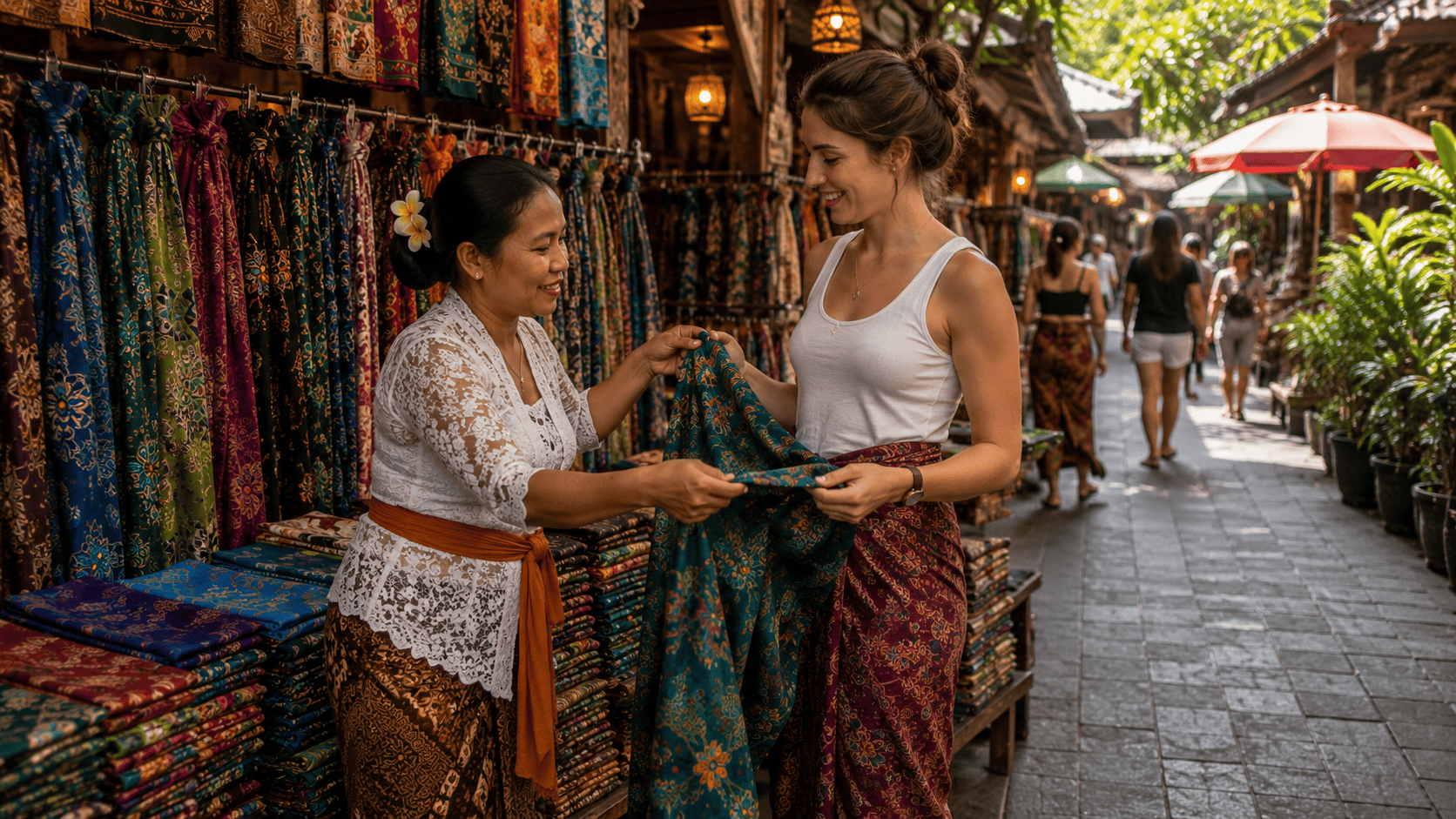
The standard temple wrap is simpler than it looks. Hold the fabric horizontally at the front of your body at waist level, then wrap it around, overlapping at the front and tucking or pinning the top edge to secure it.
The fabric should fall to at least below the knee. The sash (selendang) is then tied around the waist usually in a simple knot at the side or front. Temple entry staff will always assist if you’re unsure, and they’re accustomed to helping visitors of all experience levels get it right.
One common mistake is wearing the sarong too short it should reach well below the knee, not sit above it. Another is draping it too loosely so it falls during the visit. Pulling the fabric snug across the hip and securing the sash firmly prevents this.
If you purchase a sarong specifically for temple visits, a slightly heavier fabric holds its shape and wrap more reliably than lightweight rayon.
Explore Bali’s Culture Further with SatuSatu
Wearing the right sarong is just the first step toward engaging with Bali’s rich cultural life, and SatuSatu makes it easy to experience that culture beyond the temple gates.
SatuSatu is a Bali travel platform that brings together transport, cultural experiences, and curated activities in one place, all bookable directly on SatuSatu.com with support for local payment methods including BCA, Mandiri, OVO, DANA, credit cards, and more.
Arriving from Ngurah Rai Airport with SatuSatu’s Airport Transfer means a fixed-price, smooth arrival with no negotiating the right way to begin a culturally engaged Bali visit.
SatuSatu’s Exclusive Car Charter is ideal for temple-focused days a dedicated local driver who knows which roads lead to Besakih, Tirta Empul, and Tanah Lot, with full flexibility to set your own pace and stops.
The Kecak Fire Dance at Uluwatu is one of Bali’s most vivid cultural experiences and yes, you’ll want your sarong for the temple visit that precedes the performance. Watching the dance against a clifftop sunset is the kind of moment that stays with you.

And if you want to do more across Bali without the hassle of planning each activity separately, the SatuSatu Bali All-Access Pass is the smartest way to stretch your trip further.
Choose from a 1-day pass at $59.95 (IDR 999K), a 2-day pass at $104.95 (IDR 1.799M), or a 3-day pass at $144.95 (IDR 2.499M), and unlock access to 50+ top Bali experiences spanning destinations across the island, from the Kecak Fire Dance at Uluwatu to snorkeling in Padang Bai and wellness and spa experiences across Bali.
Every pass includes a free eSIM and a dedicated Bali concierge to handle all the planning for you, saving you up to 60% compared to booking individually, with 90-day validity from purchase for maximum flexibility.
FAQ about Bali Sarong
What is a Bali sarong used for?
In Bali, a sarong serves two distinct purposes. At temples and sacred sites, it’s worn as a symbol of respect and cultural awareness covering the body from waist to below the knee as required by Balinese Hindu tradition. At the beach or pool, sarongs are used as lightweight cover-ups and are also popular as travel souvenirs.
Do I need to bring my own sarong to temples in Bali?
Not strictly most temples provide sarongs for borrowing at the entry point, often included in the admission fee or available for a small additional charge of around IDR 15,000 to 30,000.
However, bringing your own is considered more respectful and is appreciated by temple staff. A simple, modestly colored fabric in batik or plain cloth is appropriate.
What is the difference between a sarong and a kamen?
A kamen is the specific Balinese term for the sarong worn as part of formal temple dress. It is usually worn in combination with a selendang (a sash tied around the waist).
The word “sarong” is the broader regional term and is used interchangeably by most visitors, though locals may distinguish between a kamen for sacred occasions and a sarong for everyday or beach use.
How much does a sarong cost in Bali?
Market prices vary significantly. Basic beach sarongs at Kuta or Ubud markets typically start around IDR 30,000 to IDR 70,000. Mid-range batik sarongs suitable for temple visits range from IDR 100,000 to IDR 300,000.
Genuinely handmade batik tulis pieces from artisan workshops can cost IDR 500,000 and above, and represent a meaningful souvenir with lasting value.
Where is the best place to buy a sarong in Bali?
For everyday beach sarongs and gifts, Ubud’s central market and Kuta’s Poppies Lane offer the widest variety at negotiable prices. For higher-quality batik or artisan-made pieces, Seminyak’s boutique strips and the weaving villages of East Bali near Sidemen are worth the extra effort and budget.
Always inspect the fabric carefully hand-drawn batik has irregular, nuanced patterns, while machine-printed imitations are uniform and noticeably flatter in texture.