Ubud is often called the spiritual heart of Bali and once you’ve spent a morning wandering through its temple grounds, past lotus ponds, moss-covered stone carvings, and ancient cliff-face shrines, it’s easy to understand why.
The area around Ubud holds some of the oldest and most varied sacred sites on the island, ranging from a water temple founded in 962 AD to a cave sanctuary that archaeologists believe has been in use for over a thousand years.
Whether you’re here for culture, photography, or a genuine spiritual experience, SatuSatu.com has everything you need to plan your visit from airport arrival to the day trips that cover them all.
- Pura Taman Saraswati
📍 Jalan Kajeng, central Ubud
💰 Free entry; evening dance show tickets available separately
👥 All travelers, couples, solo, families, first-time visitors
🕐 Open daily; Kecak and Legong dance performances held on select evenings
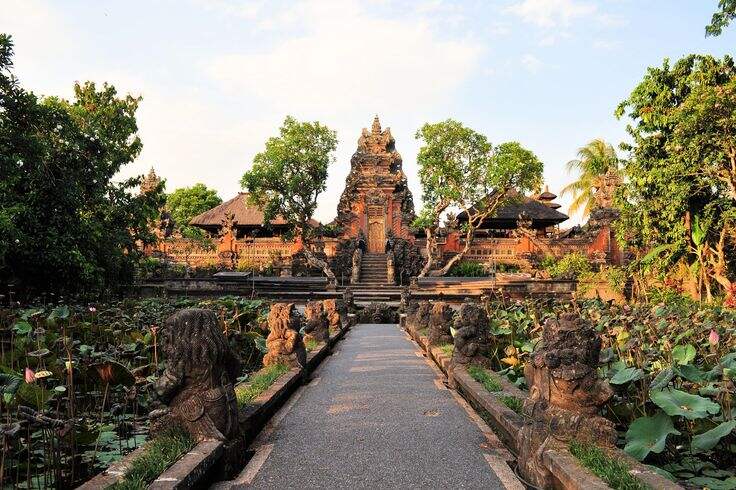
Right in the center of Ubud town, Pura Taman Saraswati is one of the most accessible and visually beautiful temple sites on the island. It was commissioned by Cokorda Gede Agung Sukawati, the Prince of Ubud, and completed in 1952 designed by the revered Balinese artist I Gusti Nyoman Lempad.
The temple is dedicated to Saraswati, the Hindu goddess of knowledge, literature, and the arts, which makes its location in Bali’s cultural capital feel entirely fitting.
The defining feature is the wide lotus pond at the entrance, crossed by a stone pathway lined with mythological statues that double as fountains. The towering split gate at the back, intricately carved with demons, flowers, and divine figures, is one of the most photographed temple entrances in Ubud and for good reason.
Tourists cannot enter the inner sanctum, which is reserved for worshippers, but the outer garden and lotus pathway are entirely open and genuinely worth the visit on their own terms.
- Goa Gajah
📍 Bedulu village, Blahbatuh, Gianyar
💰 IDR 50,000/orang (sarong included)
👥 History enthusiasts, photographers, culture seekers
🕐 8:00 AM – 5:00 PM daily
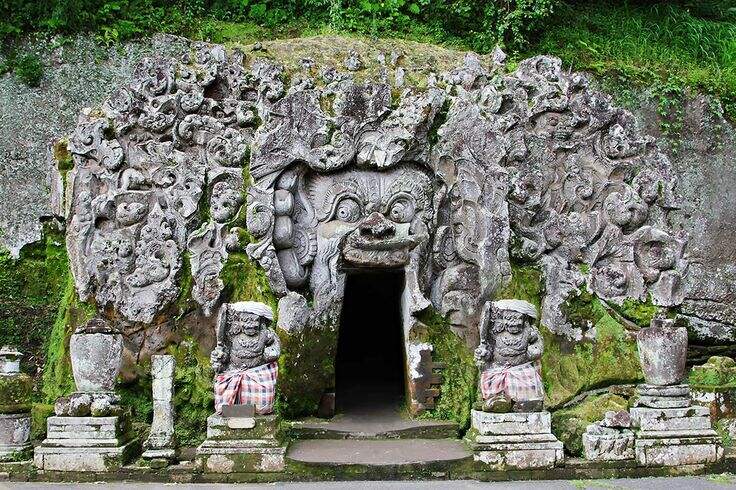
Goa Gajah literally “Elephant Cave” is one of the most distinctive temple sites in Bali. The cave entrance is carved into a cliff face in the shape of a massive gaping demon head, believed to represent Bhoma or the witch Rangda, and inside sit meditation niches with stone statues of Ganesha and the god Hariti.
Beyond the cave, ancient bathing pools with carved stone spouts open into a courtyard, and a path descends into a jungle ravine with a hidden waterfall.
Buddhist stupa carvings near the river confirm this was once a shared Hindu-Buddhist sacred site a rare religious coexistence that makes Goa Gajah genuinely unlike any other temple in the area. Optional guides are available inside for around IDR 100,000 per group.
- Pura Gunung Kawi
📍 Banjar Penaka, Tampaksiring, Gianyar
💰 IDR 50,000/orang (sarong included)
👥 Adventure travelers, history lovers, couples, photographers
🕐 8:00 AM – 5:00 PM daily
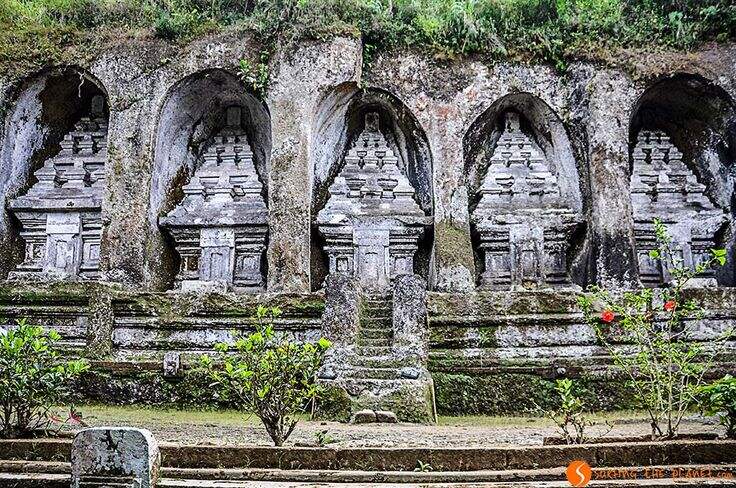
If there is one temple complex in the Ubud area that consistently surprises even experienced travelers, it is Pura Gunung Kawi. The approach alone sets the tone a 300-step descent through a lush river valley, past rice fields and stone-walled pathways, before the cliff-face shrines come into view.
The ten massive candis (memorial shrines), each standing over seven meters high, are carved directly into the sheer rock face on both sides of the sacred Pakerisan River.
They are believed to have been built in the 11th century during the reign of King Anak Wungsu of the Udayana dynasty, dedicated to the king and his royal family.
The site has a genuinely remote, ancient atmosphere that is difficult to find in more accessible parts of Bali.
It is only around 1.3 kilometers from Pura Tirta Empul, which makes combining both into a single half-day trip one of the smartest ways to experience the Tampaksiring area. The walk back up the steps in Bali’s midday heat is real going early in the morning is the best strategy both for the light and the temperature.
- Sacred Monkey Forest Sanctuary
📍 Jalan Monkey Forest, central Ubud
💰 IDR 80,000/orang (weekdays); IDR 100,000/orang (weekends & public holidays)
👥 Families, nature lovers, all types of travelers
🕐 9:00 AM – 6:00 PM daily (last entry 5:30 PM)
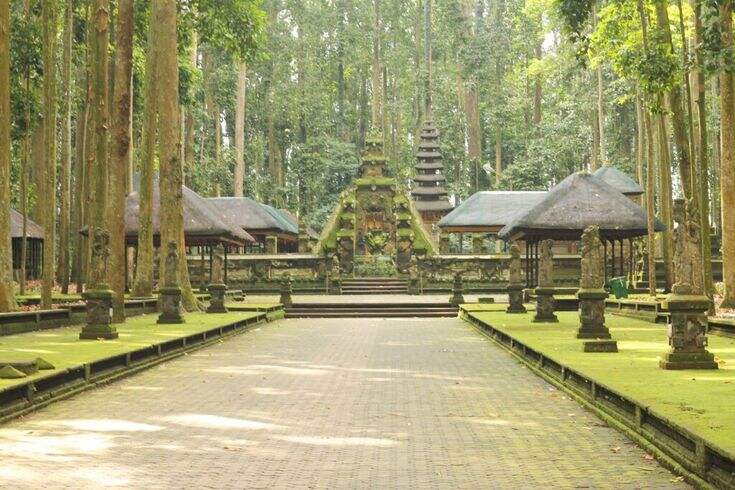
The Sacred Monkey Forest Sanctuary in Padangtegal is a 12.5-hectare nature reserve managed by the local village as a place of active worship, conservation, and ecological research.
Inside the forest sit three temple complexes: Pura Dalem Agung Padangtegal (dedicated to Shiva as destroyer), Pura Beji (a holy spring temple), and Pura Prajapati (connected to funeral rites near a traditional cemetery).
The 1,000+ long-tailed macaques roaming freely are considered sacred — but they are also uninhibited, so keep food, sunglasses, and loose items secured. Go on a weekday before 10:00 AM for the best light and smallest crowds inside the forest.
- Pura Tirta Empul
📍 Jalan Tirta, Manukaya, Tampaksiring, Gianyar
💰 IDR 50,000/orang (sarong and ceremonial sash provided)
👥 Spiritual travelers, wellness seekers, culture lovers
🕐 8:00 AM – 6:00 PM daily; arrive by 8:00–8:30 AM for the calmest experience
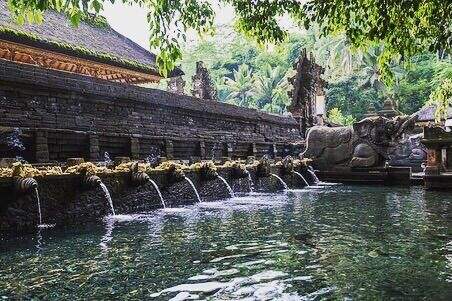
Pura Tirta Empul is the most spiritually active temple in the Ubud area. Built in 962 AD by the Warmadewa dynasty around a natural freshwater spring, the complex is the site of the Melukat purification ritual where participants wade through spring-fed pools and pray under a sequence of 30 carved stone spouts, each designated for a specific spiritual intention.
The ritual has been practiced continuously for over a thousand years, and outside visitors are genuinely welcome to participate with appropriate dress and a small canang sari offering purchased at the entrance.
Arriving by 8:00–8:30 AM gives you the best light over the stone pools and the calmest atmosphere before tour groups fill in.
Explore Ubud’s Best Temples Further with SatuSatu
Getting the most out of Ubud’s temples means having reliable, flexible transport and SatuSatu makes that straightforward from the moment you land.
Start with the SatuSatu Airport Transfer, a fixed-price, same-day bookable ride from Ngurah Rai International Airport directly to Ubud, with transparent pricing and no negotiation at the airport.
For temple-hopping days across the Ubud area covering Gunung Kawi and Tirta Empul in the morning, then Goa Gajah in the afternoon, for example the SatuSatu Exclusive Car Charter is the most practical option.
A dedicated local driver, fully flexible timing, and the freedom to adjust your route on the go, all bookable on SatuSatu.com.
Because Ubud is also the cultural heart of Bali, the Legong Dance Show Tickets at Ubud Palace SatuSatu is a natural evening add-on after a full day of temple visits.
The Ubud Royal Palace Puri Saren Agung hosts traditional Legong and other classical Balinese dance performances on a regular schedule, and pairing a temple day with an evening performance at the palace is one of the most complete cultural experiences Ubud offers.
Everything books directly on SatuSatu.com with local payment options including BCA, Mandiri, OVO, DANA, credit cards, and more.
FAQ about the Best Temples in Ubud
What are the best temples in Ubud to visit?
The five most recommended temples in and around Ubud are Pura Taman Saraswati, Goa Gajah, Pura Gunung Kawi, Sacred Monkey Forest Sanctuary, and Pura Tirta Empul.
Do I need to wear a sarong to visit temples in Ubud?
Yes, a sarong is required at every temple in Ubud and across Bali generally. Most temples provide sarongs at the entrance, either included in the entry fee or available to rent for around IDR 5,000–10,000. A ceremonial sash around the waist is also required at some sites, including Tirta Empul, where it is provided with entry.
Can tourists participate in the Melukat ritual at Tirta Empul?
Yes. Pura Tirta Empul is one of the few temples in Bali where outside visitors are actively welcome to participate in the purification ritual, provided they dress appropriately and bring a small canang sari offering, which can be purchased at the temple entrance for a few thousand rupiah.
What is the best time to visit temples in Ubud?
Early morning between 8:00 and 9:00 AM is consistently the best time. Crowds are smaller, the light is softer and better for photography, and the temperature is cooler before midday humidity sets in. For Goa Gajah specifically, afternoon light in the ravine area can also be excellent.
How do I best combine these temples in one day?
Gunung Kawi and Tirta Empul pair naturally they’re only 1.3 km apart in Tampaksiring, making a clean half-day trip from Ubud. Add Goa Gajah on the drive back. Leave Pura Taman Saraswati and the Monkey Forest for the afternoon or evening, since both are walkable from central Ubud.
A full-day car charter is the most efficient way to cover all five without the stress of coordinating separate rides.