Most travelers fly into Ngurah Rai, head straight to Canggu or Ubud, and never make it north. That is their loss, and honestly, it is what keeps Singaraja so worth visiting.
This city on Bali’s northern coast carries more history per square meter than almost anywhere else on the island, from Dutch colonial warehouses and ancient Chinese temples to a royal palace complex and a library holding over 3,000 texts inscribed on lontar palm leaves.
If you want to understand Bali beyond beach clubs and rice terrace selfies, Singaraja is where that understanding begins. The team at SatuSatu, a Bali travel platform for travelers who want to see the full picture of the island, put this guide together to help you plan a proper visit.
What Is Singaraja and Why Does It Matter?
Singaraja is the capital of Buleleng Regency and Bali’s second-largest city, with a population of over 125,000 people. Its name combines the Bahasa Indonesia words for lion (singa) and king (raja), a nod to its long history as a seat of power.
The city sits along the northern coast, facing the Bali Sea, and it served as the Dutch colonial capital of Bali for much of the 19th and early 20th centuries.
That colonial era left a physical imprint that you can still walk through today: rows of white Art Deco shop-fronts along the old harbor road, a Dutch-era bridge still standing near the waterfront, and warehouses that once handled the export trade of the island.
Before Dutch influence arrived, Singaraja was already a significant trading hub, visited by sailors and merchants from the Middle East, India, and China for centuries. Archaeological excavations in neighboring villages have traced the earliest settlements of this region back to around 400 BC.
Today it functions as an important educational and cultural center, home to two university campuses, while the surrounding Buleleng district covers a stretch of northern Bali that most visitors simply drive past on their way somewhere else.
Getting to Singaraja from South Bali
The drive to Singaraja from Kuta, Seminyak, or Canggu takes approximately 2 to 2.5 hours, depending on your route and the traffic leaving the south. From Ubud, the journey is closer to 2 hours.
The most scenic approach is via the central mountain road through Bedugul, which climbs past Lake Beratan, the Bali Botanical Garden, and the iconic Ulun Danu Beratan floating temple before descending the northern slope into Singaraja.
The alternative coastal roads from the east are longer but follow dramatic cliff-edge sections that reward the detour. Public transport options to Singaraja are limited compared to southern Bali, so most travelers hire a private driver or rent a scooter for the journey.
The city itself is navigable by the local bemo minivans that run set routes throughout for around IDR 5,000 to 10,000 per trip, or by scooter rental, which typically costs around IDR 70,000 to 100,000 per day.
The Best Things to See and Do in Singaraja
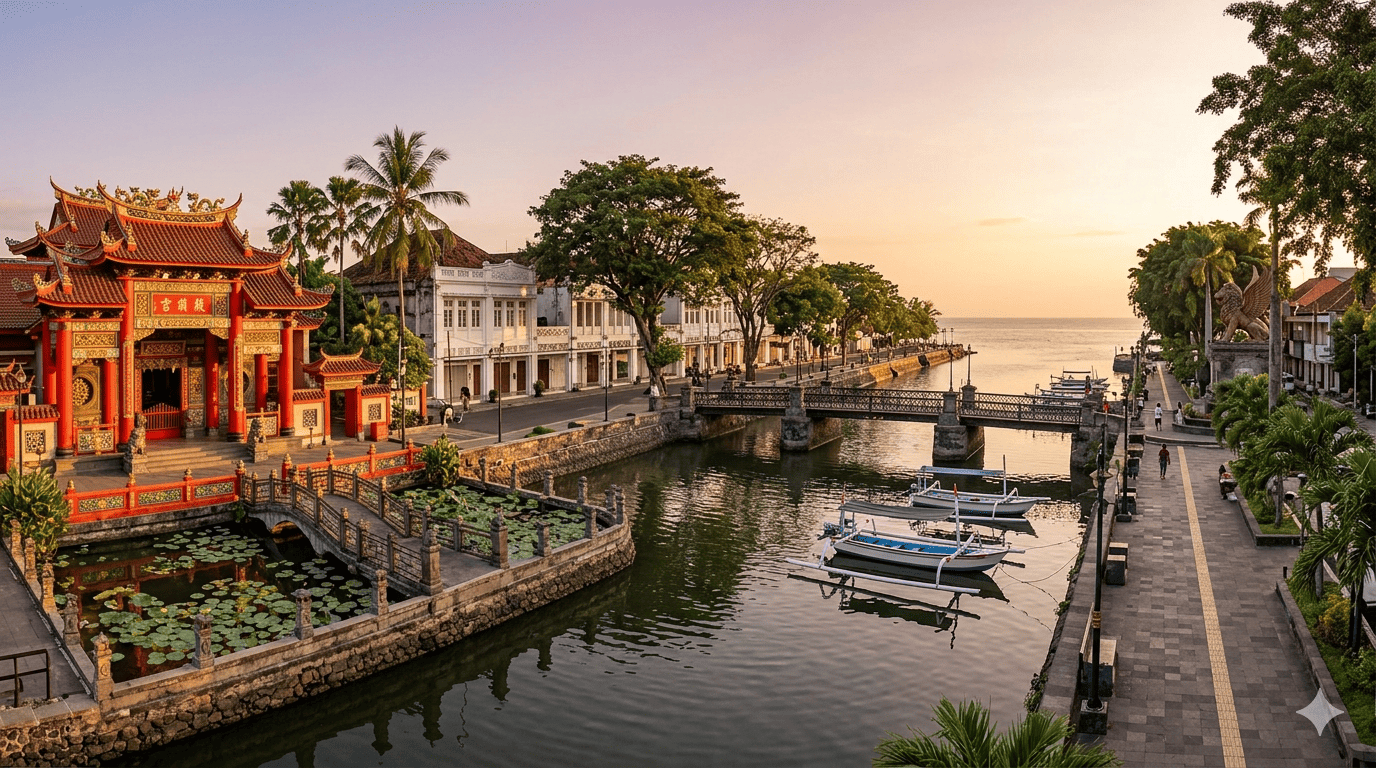
The old harbor district is the logical starting point. Walking east from the harbor along the waterfront, you pass the renovated Klenteng Ling Gwan Kiong Chinese Temple, a Tridharma place of worship with a lotus pond and vivid red-and-gold facade that reflects the centuries-old Chinese merchant influence on this part of Bali.
The white colonial shop-fronts along this stretch, built in the early 1900s with delicately carved Art Deco friezes, are among the most distinctive streetscapes anywhere on the island.
Heading south along Jalan Ngurah Rai, tree-lined with a handful of surviving colonial villas, brings you to the Tugu Singa Ambara Raja, the winged lion monument at the city’s central T-junction that has become Singaraja’s emblem.
Turn toward Jalan Veteran and you reach Gedong Kirtya, a library founded by the Dutch in 1928 that houses more than 3,000 ancient manuscripts written in Javanese kawi and old Balinese script on lontar palm leaves.
It also contains a collection of prasasti inscriptions on bronze that represent the oldest examples of writing on the island. Admission is free and the library is open Monday to Thursday from 7:30am to 3:30pm and Friday from 7am to 12:30pm.
Adjacent to the library is the Puri Kawan and Puri Agung palace complex, and across the road are the imposing gates of Puri Kanginan Palace. On a good day, visitors are sometimes invited inside to see how the royal compound is arranged and maintained.
Natural Attractions Around Singaraja
The city itself is compact and walkable for a few hours, but the real natural spectacle of the Singaraja area lies in the hills and valleys immediately to the south. Gitgit Waterfall is the most accessible of the region’s cascades, a 35-meter drop through jungle with a well-maintained walking trail of around 15 minutes from the road.
The entry fee is around IDR 45,000 and the trail passes souvenir shops and refreshment stalls with occasional wild monkeys in the trees above.
For something more dramatic, the Sekumpul Waterfalls to the southeast are considered among the most beautiful in all of Bali: a cluster of five to six cascades in a deep forested ravine, requiring a proper trek past rice terraces, temples, and a hidden village.
The Sambangan area also offers a trail system through seven waterfalls, popular with travelers who want a full morning of trekking. The Banjar Hot Springs, roughly 20 minutes west of Singaraja, provide three warm mineral pools set in a lush tropical garden, a worthwhile stop on any loop through North Bali.
Lovina and the Surrounding North Bali Coast
Most travelers who stay overnight in the Singaraja area base themselves in Lovina, a quiet coastal strip about 20 minutes west of the city center.
Lovina is known internationally for its early-morning dolphin-watching trips, where traditional outrigger boats take guests out at sunrise to encounter spinner dolphins that frequent the calm waters of Singaraja Bay.
Lovina beach itself has black volcanic sand and a relaxed, unhurried atmosphere that feels very different from the southern beaches.
To the west of Lovina, the road continues through Pemuteran, a village on Bali’s northwest coast renowned for some of the island’s best snorkeling and diving and for its coral restoration projects.
North Bali’s coastline is quieter, cleaner, and far less crowded than the south, making it a genuine antidote to the high-season density of Kuta or Seminyak.
Practical Tips for Visiting Singaraja Bali
The northern coast is generally drier than southern Bali, making it pleasant year-round, though a light jacket is useful for the mountain areas. The dry season from April to October offers the most reliable weather for trekking to waterfalls and spending time outdoors.
The local markets, particularly Pasar Anyar on Jalan Diponegoro, are best visited in the morning and offer an authentic glimpse of daily Balinese life that is completely removed from the tourist market experience in the south.
Explore Singaraja and Beyond with SatuSatu
Singaraja opens a different chapter of Bali than most travelers ever read, and having reliable transport makes the journey easy.
SatuSatu is a Bali travel platform that brings together transport, cultural experiences, and curated activities in one place, all bookable directly on SatuSatu.com with support for local payment methods including BCA, Mandiri, OVO, DANA, credit cards, and more.
Starting your Bali trip right from Ngurah Rai is simple with SatuSatu’s Airport Transfer, which offers fixed pricing, same-day booking, and a no-fuss pickup that gets you on the road north without any last-minute negotiation.
For a full day exploring Singaraja, the waterfalls, and the northern coast, SatuSatu’s Exclusive Car Charter gives you a dedicated local driver with the flexibility to stop whenever and wherever the day demands, from the lontar library to a waterfall swimming hole.
After a day in the north, rounding out your Bali trip with the sunset Kecak Fire Dance at Uluwatu offers a perfect cultural counterpoint: the ancient drama of the Ramayana performed live on a clifftop temple stage as the sun drops into the Indian Ocean.

And if you want to do more across Bali without the hassle of planning each activity separately, the SatuSatu Bali All-Access Pass is the smartest way to stretch your trip further.
Choose from a 1-day pass at $59.95 (IDR 999K), a 2-day pass at $104.95 (IDR 1.799M), or a 3-day pass at $144.95 (IDR 2.499M), and unlock access to 50+ top Bali experiences spanning destinations across the island, from the Kecak Fire Dance at Uluwatu to snorkeling in Padang Bai and wellness and spa experiences across Bali.
Every pass includes a free eSIM and a dedicated Bali concierge to handle all the planning for you, saving you up to 60% compared to booking individually, with 90-day validity from purchase for maximum flexibility.
FAQ about Singaraja Bali
What is Singaraja Bali known for?
Singaraja is Bali’s second-largest city and former Dutch colonial capital. It’s known for colonial architecture, the Gedong Kirtya manuscript library, Ling Gwan Kiong Temple, and as the gateway to North Bali attractions like waterfalls, hot springs, and Lovina.
How far is Singaraja from Ubud and Kuta?
Singaraja is around 2 hours from Ubud and 2–2.5 hours from Kuta by car. The scenic Bedugul route passes Lake Beratan and Ulun Danu Beratan Temple.
What waterfalls are near Singaraja?
Gitgit Waterfall is the closest major waterfall, about 20 minutes south. Sekumpul Waterfall and the Sambangan waterfalls trail are further south and require longer treks.
Is Singaraja worth visiting on a day trip from Ubud or Kuta?
Yes. Singaraja and North Bali make a great full-day or two-day trip with colonial sites, markets, waterfalls, Banjar Hot Springs, and Lovina all reachable with a private driver.
Where should I stay when visiting Singaraja?
Most travelers stay in Lovina, a quiet beach area about 20 minutes west of Singaraja, popular for dolphin-watching and North Bali day trips.