Ask any food-curious traveler what surprised them most about eating in Bali, and there is a good chance the answer involves tempeh.
Not the thin, pale slabs you might have encountered at a health food cafe back home, but something entirely different: deep golden, nutty, and deeply satisfying in ways that are hard to explain until you’ve tried it here. Tempeh is not just a protein substitute in Indonesian cooking.
It is a cultural institution with centuries of history, and Bali is one of the best places in the world to experience it in its full, unfiltered form.
SatuSatu, a Bali travel platform dedicated to helping visitors connect with the island’s genuine food and cultural landscape, put together this guide to help you understand and taste tempeh properly before your trip.
What Is Tempeh and Where Does It Come From?
Tempeh is a fermented soybean cake made by cultivating soybeans with a mold culture that binds the beans into a firm, sliceable block. The result is a food with a dense, slightly earthy flavor, firm texture, and a nutritional profile that includes complete protein, dietary fiber, and a range of vitamins.
It is one of the rare fermented foods that originated in Southeast Asia rather than East Asia, with its earliest written record traced to a 19th-century Javanese literary poem called the Serat Centhini.
While tempeh is most closely associated with Central and East Java, where it first developed, it spread across the Indonesian archipelago and became a cornerstone ingredient in Balinese cooking.
Indonesia has nominated tempeh for UNESCO Intangible Cultural Heritage status, with the most recent submission in 2025 moving forward for consideration by UNESCO’s Intergovernmental Committee. That process reflects how seriously Indonesians regard this food as a living cultural artifact.
How Is Tempeh Used in Balinese Cooking?
In Bali, tempeh appears in many forms, but a few preparations are especially beloved. Tempe goreng is the simplest and most widespread: slices of tempeh fried in coconut oil until golden and crispy, served as a side dish with rice and sambal at virtually every warung on the island.
The outside crisps beautifully, while the inside stays firm and nutty. It takes seasoning extraordinarily well, which is why Balinese cooks often add garlic, turmeric, or kaffir lime to the frying oil.
Tempe orek is a dry stir-fry preparation where tempeh cubes are cooked in sweet soy sauce with garlic, shallots, and occasionally chilli until the sauce caramelizes and each piece is glazed and sticky. This dish packs a sweet-savory intensity that makes it addictive alongside steamed rice.
Tempe mendoan, while more closely associated with Central Java, also appears in Bali: a lighter batter fry that leaves the inside barely cooked and the outside just set, served with sweet soy and fresh chilli.
At upscale Balinese restaurants, tempeh takes on more elevated forms. Merah Putih restaurant in Seminyak, for example, uses tempeh as the center of sate tempe: skewers of chargrilled tempeh with capsicum and leek, served alongside peanut sauce.
This kind of presentation shows how deeply the ingredient bridges traditional and contemporary Balinese cuisine.
Where to Eat Tempeh in Bali
The honest answer is: almost everywhere. In a traditional warung serving nasi campur, tempeh will appear as a side dish alongside rice, vegetables, and your choice of protein.
Look for it also in gado-gado, Bali’s beloved peanut sauce salad that combines blanched vegetables, tofu, boiled egg, and tempeh in a sweet-spicy dressing that is one of the island’s great vegetarian dishes.
In Canggu, Seminyak, and Ubud, tempeh appears on the menus of health-focused cafes in bowls, sandwiches, and grain plates, sometimes marinated, sometimes smoked, sometimes prepared in ways that bear little resemblance to the original.
There is nothing wrong with these modern versions, but if you want to understand tempeh’s true character, eat it at a warung first.
Tempeh Cooking Classes in Bali
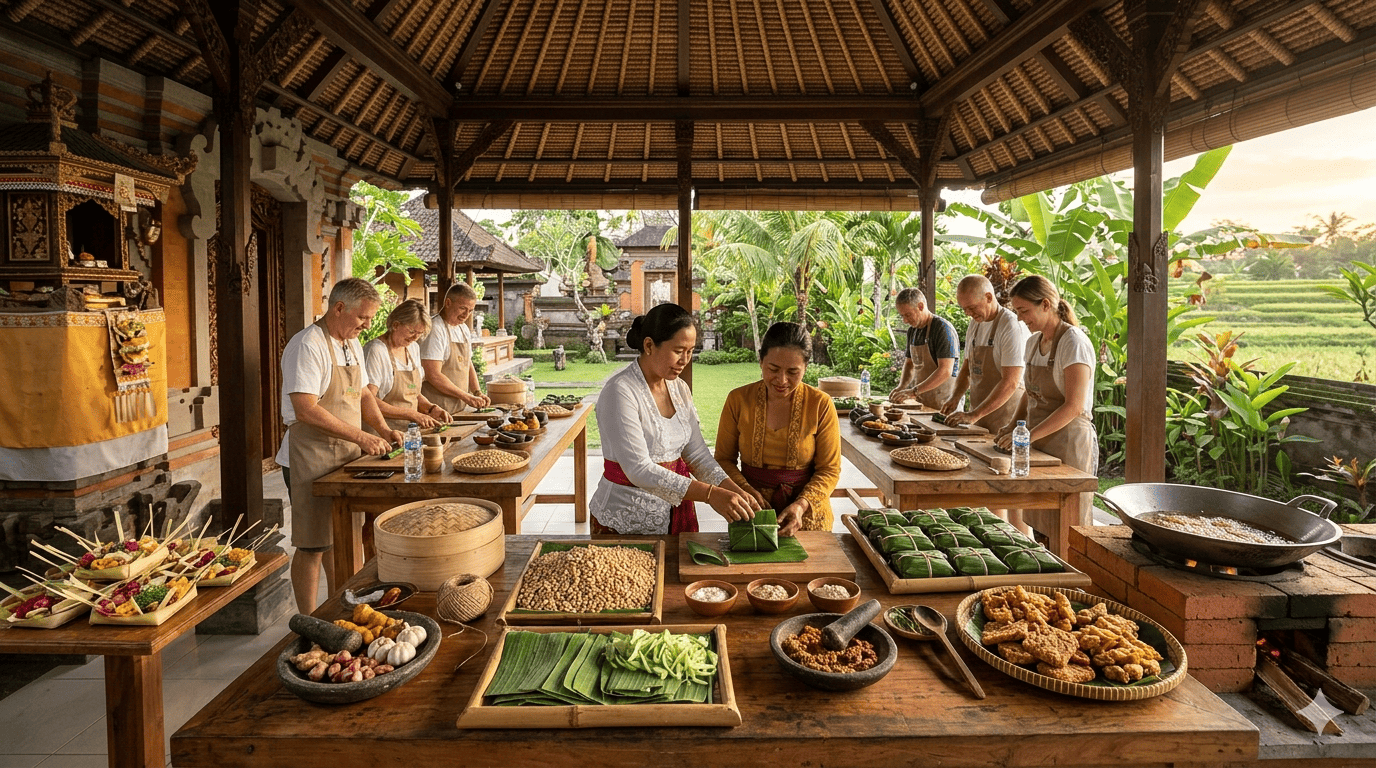
One of the most rewarding ways to connect with tempeh culture while in Bali is through a cooking class that includes tempeh-making from scratch. In Denpasar, a small number of family-run cooking experiences walk visitors through the full fermentation process alongside traditional Balinese dishes.
These classes typically take a full morning, end with a shared lunch of everything prepared, and send participants home with a recipe booklet.
Travelers who have done these sessions consistently describe the tempeh-making component as a genuine highlight, particularly the tactile process of wrapping the inoculated soybeans in banana leaves or plastic for the fermentation period.
Beyond the food itself, these classes provide rare access to residential Balinese family life and cooking traditions that are not visible from the streets of Seminyak or Canggu. If you have two or three hours to spare and any interest in food culture, it is time well spent.
Why Tempeh Matters Beyond the Plate
Part of what makes tempeh worth understanding is what it represents in Indonesian culture.
It is a food born from creativity with limited resources: soybeans were fermented not because it was fashionable, but because fermentation extended shelf life, improved nutrition, and made protein accessible to communities that could not afford meat regularly.
That origin gives tempeh a kind of democratic, communal significance that has never been forgotten even as the ingredient travels the world and appears on menus in New York and London.
In Bali, eating tempeh at a traditional warung is a small act of connection with that history. You are eating what millions of Balinese families have eaten at their tables for generations, prepared in a way that has barely changed.
That context adds a dimension to the flavor that no amount of truffle or fermented chilli paste can replicate.
Explore Bali’s Food Culture Further with SatuSatu
Tempeh is just one thread in Bali’s extraordinarily rich food culture, and SatuSatu can help you follow those threads much further.
SatuSatu is a Bali travel platform that brings together transport, cultural experiences, and curated activities in one place, all bookable directly on SatuSatu.com with support for local payment methods including BCA, Mandiri, OVO, DANA, credit cards, and more.
Start every Bali trip right with SatuSatu’s Airport Transfer, offering fixed pricing and same-day booking so you arrive at Ngurah Rai and head straight into Bali without the stress of negotiating transport.
To explore Bali’s food regions beyond your home base, SatuSatu’s Exclusive Car Charter pairs you with a dedicated local driver and total schedule flexibility, whether you’re heading to a morning market in Ubud or a warung crawl through Sanur.
When the sun goes down, there is no more memorable Bali experience than the Kecak Fire Dance at Uluwatu: Balinese Hindu mythology performed at sunset with the clifftop temple and Indian Ocean as backdrop.

And if you want to make the most of every day in Bali, the SatuSatu Bali All-Access Pass unlocks 50+ curated island experiences in one practical, flexible package.
Choose from a 1-day pass at $59.95 (IDR 999K), a 2-day pass at $104.95 (IDR 1.799M), or a 3-day pass at $144.95 (IDR 2.499M), and unlock access to 50+ top Bali experiences spanning destinations across the island, from the Kecak Fire Dance at Uluwatu to snorkeling in Padang Bai and wellness and spa experiences across Bali.
Every pass includes a free eSIM and a dedicated Bali concierge to handle all the planning for you, saving you up to 60% compared to booking individually, with 90-day validity from purchase for maximum flexibility.
FAQ about Tempeh Bali
What is tempeh in Bali?
Tempeh in Bali is a fermented soybean cake that is a staple ingredient in Balinese cooking. It appears as a fried side dish, stir-fry, or component in dishes like gado-gado and nasi campur. The Balinese version is most commonly deep-fried and served crispy alongside rice and sambal.
Is tempeh a traditional Balinese food?
Tempeh originated in Java and spread across the Indonesian archipelago including Bali. While not exclusively Balinese in origin, it is a deeply embedded part of Balinese everyday cooking and appears at virtually every traditional warung on the island.
Where can I learn to make tempeh in Bali?
Family-run cooking classes in Denpasar and other parts of Bali offer sessions that include traditional tempeh-making alongside Balinese dish preparation. These typically run for a full morning and include a shared meal.
Is tempeh vegan-friendly?
Yes. Tempeh is made from soybeans and is fully plant-based, making it one of the most widely available vegan protein sources in Bali. It appears in many vegan and vegetarian dishes across the island.
Has tempeh been recognized by UNESCO?
Indonesia nominated tempeh for UNESCO Intangible Cultural Heritage status multiple times, with the 2025 submission moving forward for consideration by UNESCO’s Intergovernmental Committee. A final decision is expected through the official UNESCO review process.