The tree house in Nusa Penida, officially known as Rumah Pohon Molenteng, is one of Bali’s most talked-about spots: a cluster of small wooden tree houses perched on a cliff on the eastern side of Nusa Penida island, overlooking the ocean, Diamond Beach, and the famous Raja Lima (Thousand Islands) viewpoint below.
It went viral on social media years ago and has stayed relevant ever since. SatuSatu gives you the honest breakdown of what it is, what visiting actually involves, and whether an overnight stay is worth booking.
What Is the Tree House Nusa Penida?
Rumah Pohon, which translates as “tree house” in Bahasa Indonesia, is a small eco-accommodation and viewpoint located in the village of Pejukutan on the eastern cliffs of Nusa Penida.
The full name of the site is Rumah Asli Molenteng, after the local village. There are three tree houses on the property, each built from natural materials using traditional construction methods, designed to blend with the surrounding environment rather than impose on it.
The houses have electricity for fans and lighting, and the location sits on Bukit Molenteng hill, which also provides access to two of Nusa Penida’s best viewpoints: the Raja Lima viewpoint and the Thousand Islands panorama.
These are not simply photo backdrops. They are genuine, staggering coastal views that photographers and non-photographers alike react strongly to.
Location and Getting There
Rumah Pohon is located on the eastern side of Nusa Penida, approximately 25 kilometres from the main port of Toya Pakeh and 20 kilometres from the town of Sampalan.
Getting there requires taking a fast boat from Bali’s southern coast, typically from Sanur, then renting a scooter on the island. Scooter rentals are available near the Toya Pakeh harbour for roughly IDR 70,000 per day.
The road to the eastern side of the island includes some rough and hilly stretches, so confident riding is important. For those who prefer not to scooter, hiring a local driver for the day is a sensible alternative.
Once at the site, there is a small parking area. A modest entrance fee applies for visiting the cliff area and viewpoints, currently around IDR 25,000 per person. Photo spot fees apply separately for time at the treehouse itself.
The dry season between April and October is the best time to visit. During the wet season, the access road can become slippery.
The Tree House Nusa Penida Experience: Staying Overnight and Visiting by Day
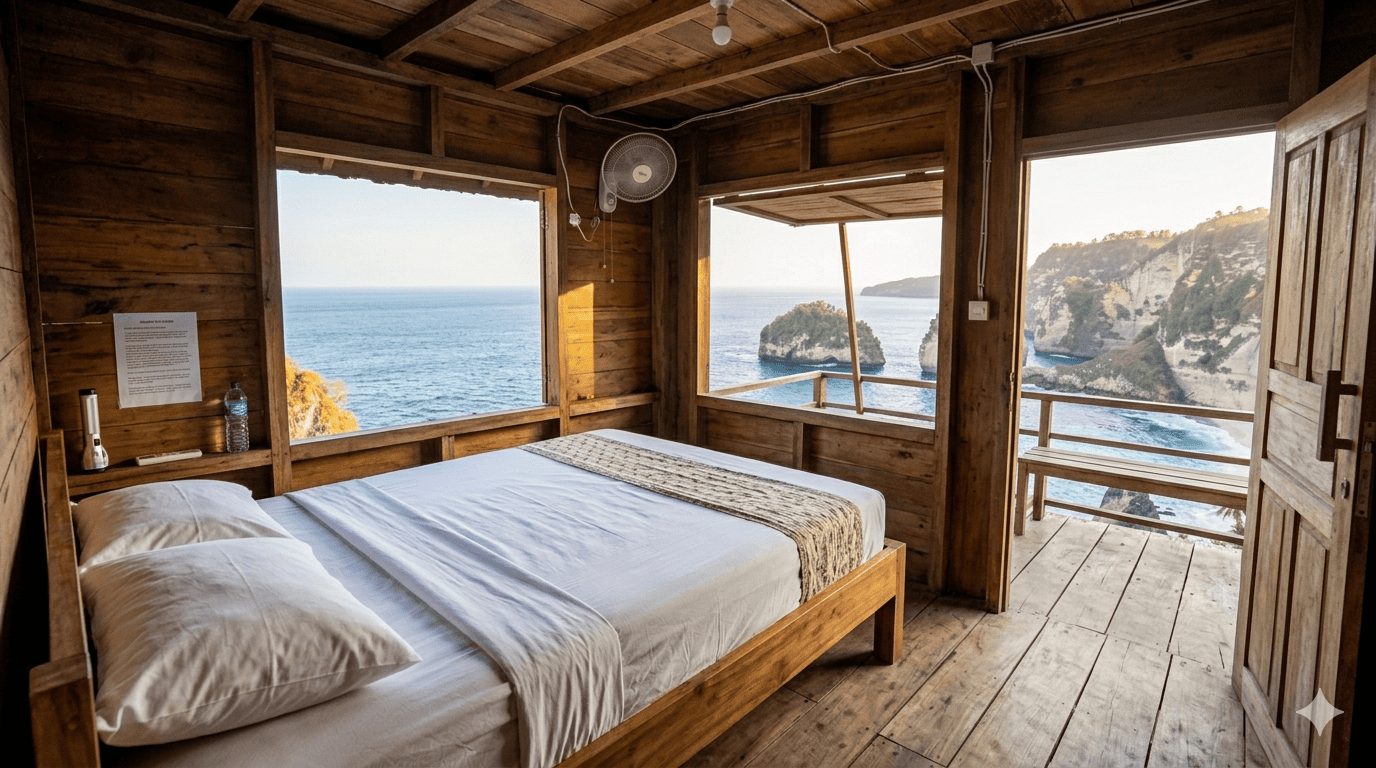
Visiting the tree house as a day tripper and staying overnight are two quite different experiences. For day visitors, the draw is the view and the photo opportunity.
The cliff-facing position of the houses, with deep blue ocean below, the scatter of rocky islands at the Thousand Islands viewpoint, and the cliffs of Diamond Beach visible nearby, creates scenery that holds up even in person.
Arriving before sunrise is strongly recommended, as the cliffs face east, catching the first light beautifully. After 7 AM, the sun angle makes photography harder and the site gets busier.
For overnight guests, there are three tree houses bookable as accommodation, priced at around IDR 550,000 per night (approximately $35 USD), though pricing may vary. The beds and rooms are deliberately simple.
There is no WiFi, minimal phone signal (a Telkomsel SIM helps), and the shared bathroom facilities are basic.
However, guests who stay overnight consistently describe being woken by the sound of crashing waves and opening their eyes to one of the most extraordinary views available anywhere on the island. Dolphins and manta rays are sometimes visible from the cliff in the early morning hours.
Being honest: the accommodation itself is bare-bones. What you are paying for is the location, the silence after day visitors leave, and the sunrise experience. If that trade-off feels worth it, the stay tends to be genuinely memorable.
Why the Tree House Nusa Penida Stands Out
There is nothing else quite like Rumah Pohon Molenteng in Bali. The concept, a simple wooden platform in the trees on a clifftop, watching the sun rise over a scatter of islands with waves 80 metres below, is the kind of thing that justifies an entire trip to Nusa Penida.
The site also embodies the Balinese concept of Tri Hita Karana, living in harmony with people, the natural world, and the spiritual. The minimal-impact construction and the way the houses sit within the trees rather than on top of them reflects that philosophy in a tangible way.
The Thousand Islands viewpoint accessed from the same site adds a second major reason to be there. It features a small warung where you can sit with a cold drink and absorb the view of five large rocks scattered across the ocean below.
Combining both viewpoints in a single visit makes the journey from the western side of the island feel very worthwhile.
The area is also conveniently close to two of Nusa Penida’s best beaches. Atuh Beach and Diamond Beach are both reachable within a short scooter ride, making the eastern Nusa Penida circuit one of the most rewarding half-day itineraries on any of Bali’s islands.
The Honest Verdict: Is the Tree House Nusa Penida Worth It?
For a day visit, yes without question. The entrance fee is minimal, the views are world-class, and arriving early enough to beat the crowds turns the experience into something genuinely peaceful. Sunrise at Rumah Pohon is one of those travel moments that stays with you.
For an overnight stay, it depends entirely on your expectations. If you go in knowing that you are choosing a raw, off-grid experience for the sake of a singular sunrise and the unusual pleasure of sleeping above the ocean, you will almost certainly find it worthwhile.
If you need reliable hot water, WiFi, or comfortable amenities, this is not the right place. Book well in advance as there are only three units, and demand fills them months ahead, especially in dry season.
Explore Further with SatuSatu
Nusa Penida is one of Bali’s most dramatic destinations, and SatuSatu makes connecting your island adventures to the wider Bali experience straightforward.
SatuSatu is a Bali travel platform that brings together transport, cultural experiences, and curated activities in one place, all bookable directly on SatuSatu.com with support for local payment methods including BCA, Mandiri, OVO, DANA, credit cards, and more.
Before crossing to Nusa Penida, set the tone for your trip with the Kecak Fire Dance at Uluwatu, Bali’s most iconic sunset performance at the clifftop Uluwatu Temple. It is a powerful contrast to the raw natural beauty waiting for you on the island.
For travelers who want to experience more of what Bali and its islands offer in a single trip, the SatuSatu Bali All-Access Pass is built for that.

Choose from a 1-day pass at $59.95 (IDR 999K), a 2-day pass at $104.95 (IDR 1.799M), or a 3-day pass at $144.95 (IDR 2.499M), and unlock access to 50+ top Bali experiences spanning destinations across the island, from the Kecak Fire Dance at Uluwatu to snorkeling in Padang Bai and wellness and spa experiences across Bali.
Every pass includes a free eSIM and a dedicated Bali concierge to handle all the planning for you, saving you up to 60% compared to booking individually, with 90-day validity from purchase for maximum flexibility.
FAQ Tree House Nusa Penida
What is the tree house in Nusa Penida?
The tree house in Nusa Penida is Rumah Pohon Molenteng, a small eco-accommodation and viewpoint on the eastern cliffs of the island in Pejukutan village, featuring three bookable wooden tree houses and panoramic ocean views including the famous Raja Lima (Thousand Islands) viewpoint.
How much does it cost to visit the tree house Nusa Penida?
A site entrance fee of around IDR 25,000 per person applies for visiting the viewpoint area. Overnight stays in the tree houses cost approximately IDR 550,000 per night (around $35 USD), though prices may vary. Separate photo spot fees apply at the tree houses themselves.
Can you stay overnight at the tree house Nusa Penida?
Yes. There are three tree houses bookable as accommodation. The rooms are simple and off-grid with no WiFi and basic shared facilities, but guests consistently rate the sunrise experience and ocean sounds as unforgettable. Booking well in advance is essential as availability is very limited.
What is the best time to visit the tree house Nusa Penida?
The dry season from April to October is ideal, with July to September being the clearest months. For the best experience, arrive before sunrise as the cliffs face east and early light creates the most dramatic conditions, both for photography and for the view itself.
What else is near the tree house Nusa Penida? Atuh Beach and Diamond Beach are both a short scooter ride away, making the eastern Nusa Penida circuit one of the best half-day itineraries on the island. The Thousand Islands viewpoint is also accessible from the same site.